Higham Lane School
Fine Art
faqs
Do I need to have studied GCSE Fine Art?
You do need to have studied one of the endorsements under the GCSE art and design suite at GCSE. We recommend that you have achieved at least a grade 6 at GCSE and if your GCSE is in a non drawing endorsement e.g. photography, we would like to see a portfolio of drawings.
What themes will we study?
After the initial induction phase, we will help you establish your strengths and interests to allow you to build a successful personal investigation (portfolio) based around a theme of your choice. The possibilities really are endless. The most important thing is not the theme itself, but that you are engaged and curious enough to explore it to a deeper level.
Is there any written work to do?
Part of your personal investigation will include your analytical skills. You will be asked to research and evaluate the work of artists, designers and craftspeople relevant to you project. There is also a stand alone essay called the related study. this has to be a minimum of 1000 words and will require further research skills. We provide writing frames and essay structures to help you as well as allowing you to submit a number of drafts before the final submission. This is great preparation for the extended writing you can expect at university.
Context:
With one in twelve jobs in the UK in the creative industries, why wouldn't you want to be a part of it?
Whether you see yourself as a designer, architect, film maker, photographer or the next big games designer, this could be the creative course for you.
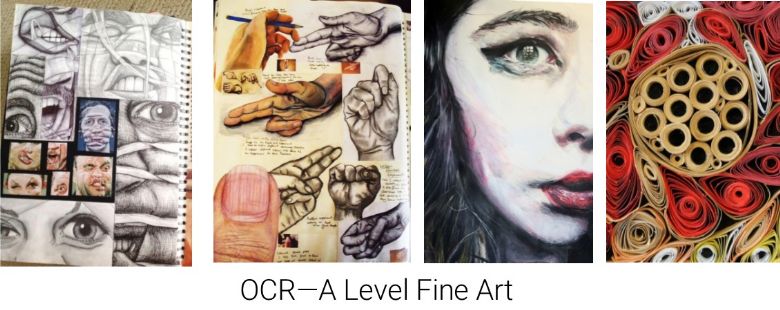
A Level Fine Art is a bridge to further education in the creative sector. The course is structured in a similar way to the GCSE course allowing students to consistently build their skills in a range of areas. Students will initially be expected to explore a range of processes before research into their chosen theme. In preparation for University or placements within the arts, students will be self-motivated, inquisitive and critical of their work and that of others. They will be guided by subject staff to work within their strengths and interests. They will gain experience of working with a range of materials such as; drawing, painting, printing, 3D work as well as digital processes and photography. Students will then focus to refine their skills and deepen their understanding of the creative processes desired by many industries. In turn students will build their transferable skills, creative thinking and ability to independently build a portfolio to be proud of but more importantly open doors.
Exam Board:
OCR (H601)
Assessment:
60% Personal Investigation (coursework)
40% Externally set task (exam)
Course Details:
Learners should be able to explore:
- Artists, Craftspeople and designers
- A range of Fine Art media
- Personal themes
- Learners will record through:
- Drawing
- Photography
- Annotations
- Other visual forms
Suggested areas of study:
Portraiture, Landscape, Still Life, Human Form, Abstraction, Experimental Imagery, Narrative or Installation.
Skills:
- Understanding the use of pictorial and real space, composition, rhythm, scale and structure
- Understand the application of the formal elements
- Developing, selecting and refining work
- Using appropriate visual language and terminology
- Manipulate imagery
Knowledge and Understanding:
Learners must use an appropriate range of processes and techniques using traditional and/or digital media suitable for the chosen subject area.
Learners will build and evidence an understanding of:
- Relevant technologies, materials, processes and resources.
- Styles and traditions of the relevant area of study.
- How ideas and feelings can be conveyed and interpreted in images and artefacts.
- How images and artefacts relate to the time and place in which they were made.
- A working vocabulary and specialist terminology relevant to their area of study.
Other Learning Opportunities:
Educational visits, Exhibitions, Support to KS3 and 4, 6th form workshops.
Where next with this course?
After successfully completing A Level Fine Art students will be encouraged to apply for one of the local foundation courses. This is an essential course to help students experience a full range of artistic techniques and processes before applying for a creative degree. This is a fully funded year and provides students with an opportunity to really consider their degree choices. Creative degrees can lead to any one of the 2.62 million creative jobs in the U.K. Some of these are:
Curator, Artist, Sculpture, Fashion Design, Theatre and TV set design, Jewellery Making, Ceramics, Fashion Photography, Commercial Photography, Sports Photographer, Events Photographer, Teacher, Lecturer, Tattooist, Gallery Work, Installation, Community Work, Art Therapy, Architecture
For further details on this subject, please fill in Course Enquiry form