
Higham Lane School
Understanding Progress 8 - Information for Parents and Carers
What is Progress 8?
- Progress 8 is a new secondary accountability measure aimed at measuring the progress of pupils across a selected set of 8 subjects.
- It is a type of value added measure, meaning that pupils’ results are compared to the actual achievements of other pupils with the same prior attainment.
Attainment 8
- Attainment 8 is a measure of a pupil’s average grade across a set suite of eight subjects.
- Grades will be measured on a 1-8 point score scale, rather than the current 16-58 scale.
- On this scale, 1 is equivalent to a Grade G GCSE, 4 is equivalent to a Grade C and 7 is equivalent to a Grade A GCSE.
The Attainment 8 “buckets”
- The Attainment 8 measure will take the average of a pupils points across a set of their best 8 subjects.
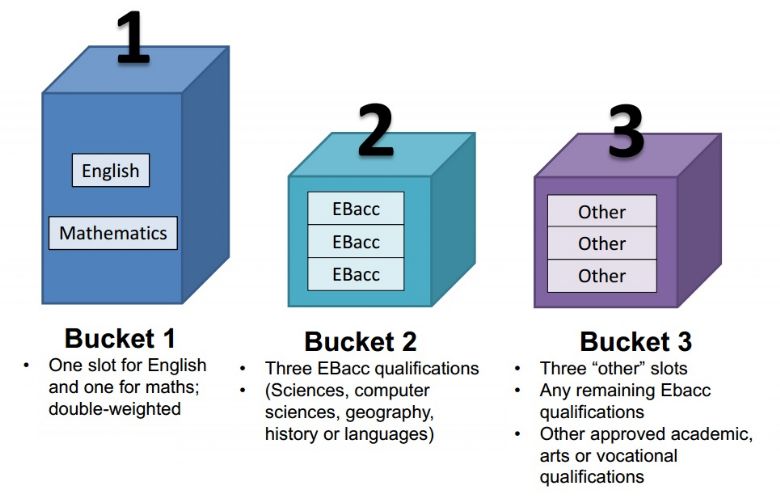
- The 8 qualifications that count towards the Attainment 8 measure must fall into one of three “buckets.” If a qualification does not fall into one of these buckets, it is not counted in the attainment 8 (or progress 8) measure.
The Attainment 8 Buckets
Calculating Progress 8 for schools
- The school’s Progress 8 score is the mean average of its pupils’ Progress 8 scores.
- This is therefore calculated by adding each individual pupil’s Progress 8 score, and then dividing this total by the number of pupils.
How is Progress 8 used?
- The Progress 8 measure will be the only measure used for Department for Education floor standards.
- A school will fall below the new floor standard if their Progress 8 score is below -0.5
- This score would indicate that the average achievement of a school’s pupils is half a grade worse per subject than the national average of other pupils with the same prior attainment.
Progress 8 (explained in 3 minutes) - YouTube video